

Ethical Management System
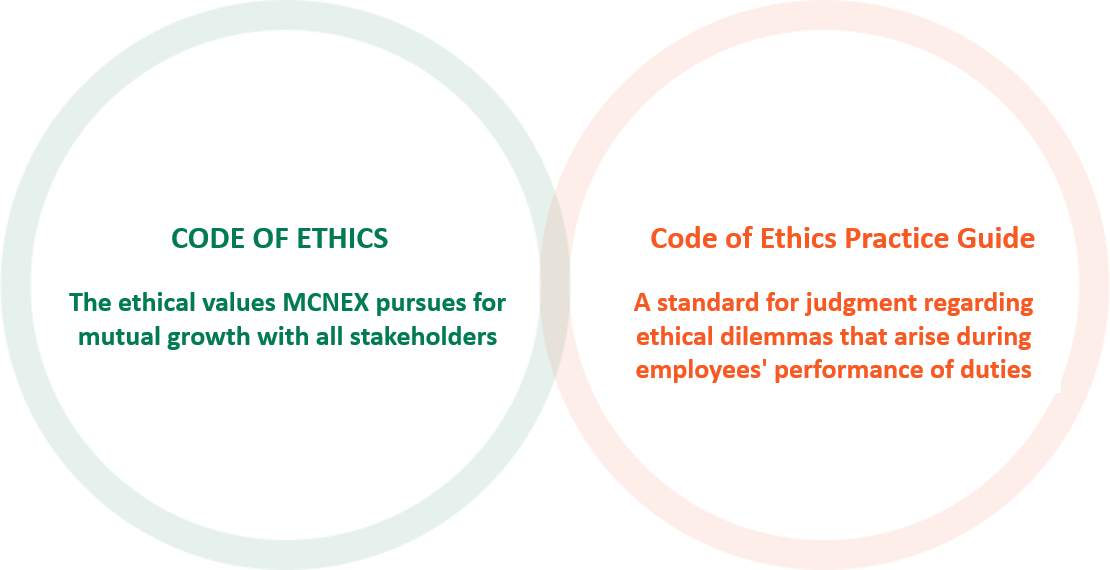
To establish an ethical corporate culture through transparent management and continuous innovation, MCNEX has enacted its 'Corporate Code of Ethics' and 'Code of Ethics Practice Regulations.' The Corporate Code of Ethics and the Code of Ethics Practice Regulations serve as the standard for employee decision-making and value judgments, applying to all employees, including regular and contract staff. MCNEX strives to practice 'Righteous Management' (Jeongdo Gyeongyeong) by providing annual training on the content of these ethical regulations to all employees.
Ethical Management Activities
To establish an ethical corporate culture and grow together with all stakeholders through honest and fair business activities, MCNEX actively practices ethical management.
MCNEX mandates that new employees sign a Code of Ethics and an Integrity Pledge upon joining, and continuously monitors ethical risks by operating its ESG Hotline System on the company website. Through this monitoring, the company proactively identifies negative ethical risks to prevent incidents from escalating or spreading, and eradicates risk-generating factors by implementing improvement measures for any vulnerabilities found in its ethical management system. Furthermore, while fully committed to preventive training, MCNEX takes thorough and strict post-incident measures for any cases of corruption, based on rigorous standards. For employees involved in corruption, MCNEX takes disciplinary action. In addition, for any stakeholder who has provided cash or other valuables to an employee, measures such as suspension of business or demanding recurrence prevention plans are taken, depending on the severity of the matter.
Since 2022, MCNEX has provided ethics training for all employees (excluding those on childcare leave and expatriates at the Vietnam subsidiary) and has also conducted training for its Executive Directors. Additionally, the training curriculum includes topics such as the prohibition of anti-competitive practices and information security.
Ethics & Fair Trade Training
Title | Content | Organizer | Participants | Executive Director | Method |
|---|---|---|---|---|---|
Internal | 1. Fair Trade Guidelines | Internal | 487 | 2 | In-person |
Fair Trade Guidelines
In pursuit of fair competition with its competitors and mutual growth with its suppliers, MCNEX complies with the Fair Trade Act and strictly prohibits unfair collaborative acts (cartels), unfair trade practices, and improper internal transactions. Furthermore, to ensure employees are fully aware of these matters and do not commit violations during their work activities, MCNEX has established and distributed 'Fair Trade Guidelines' via its internal intranet.
The Fair Trade Guidelines contain key provisions on representative unfair practices, such as the prevention of collusion, prohibition of unfair trade practices, regulation of improper internal transactions, and prevention of the abuse of a market-dominant position. In particular, they include specific examples of violations for each type of unfair practice, along with behavioral guidelines, to help employees easily understand the content.
Ethical Management Risk Management
To proactively prepare for key ethical management risks, MCNEX conducted an integrity survey composed of a checklist covering items such as abuse of power (Gapjil), improper solicitation, conflict of interest, and personnel matters. A total of 142 headquarters employees participated in this survey. The results showed high performance ratings in areas like 'efforts to protect whistleblowers on corruption and public interest issues' and 'abuse of power (Gapjil) practices, including unfair demands, orders, and refusals.' Additionally, for areas requiring improvement, such as for-profit activities related to an employee's duties, MCNEX plans to establish and implement improvement tasks.
MCNEX VINA conducted a workplace ethics risk assessment following the labor and business ethics risk assessment process of the RBA (Responsible Business Alliance), a global initiative. The company evaluates and analyzes risks identified through this assessment based on factors including likelihood, risk level, frequency, and severity. MCNEX implements improvement activities for identified risks according to their priority, striving for their elimination. For risks that cannot be completely eliminated, the company makes utmost efforts for their minimization and prevention.
Ethical Management Reporting Channel
To respond to inquiries and requests regarding all aspects of sustainability management, including ethical management and human rights, MCNEX has introduced its ESG Hotline System. This hotline system allows stakeholders (such as employees, suppliers, customers, and local communities) to submit reports anonymously through various channels including email, mail, and telephone. The identity of the reporter and the content of the report are treated confidentially to guarantee anonymity.
Reporting Channels
To | ESG Management Team in MCNEX | TEL | 070-8630-6804, FAX : 02-2025-3606 |
|---|---|---|---|
ESG@mcnex.com | Post | MCNEX TOWER. 13-39, Songdogwahak-ro 16beon-gil, Yeonsu-gu, Incheon, Republic of Korea |